



AI · AGENTS · LESSONS LEARNED
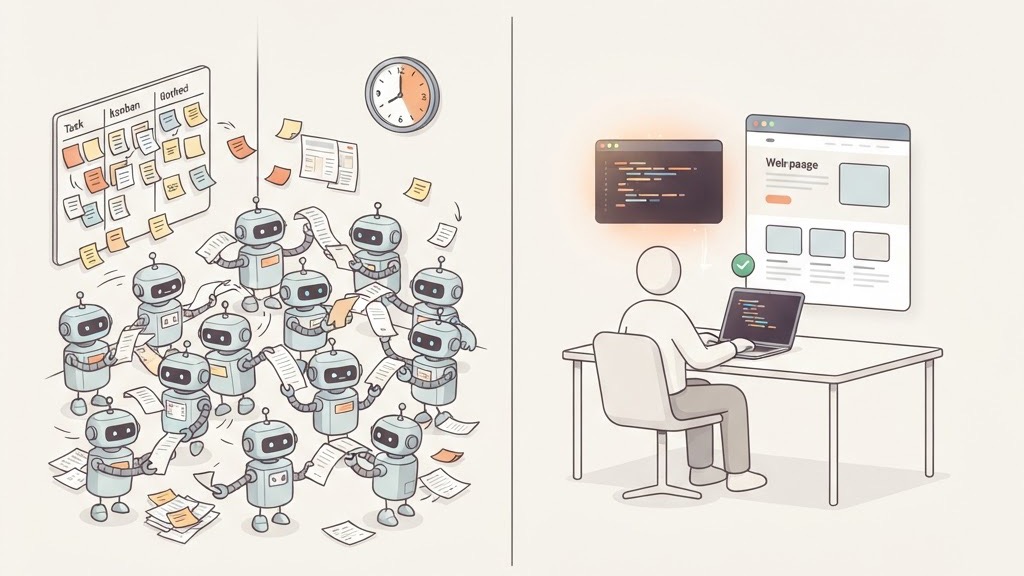
At home, a small team of AI agents runs around the clock. Hermes, the main bot, receives my requests on Telegram and hands them to specialists: one bot for infrastructure, one for home automation, one for movies, one for health… On paper, it is the most powerful setup I have ever built: long-term memory, a shared kanban board, dozens of installed skills, automatic routing between models.
One Saturday evening, I asked it for something simple: fix a display issue on a web page. An hour later, I still had nothing. I opened Claude Code on my Mac, pasted the conversation in, and the issue was fixed within minutes.
This post tells the story of that evening, because it says something important about AI agents today.
An Hour of Kanban for a Page Layout
Here is what happened, in order:
- Hermes turns my request into a kanban card for an agent, rephrasing it along the way.
- The agent blocks the card: my request is not clear enough. A multiple-choice question.
- New card, new block: changing its own behavior requires approval. Another question.
- I insist: I want a result. Hermes creates a third card, longer than the previous one: diagnose the briefing, prepare an offline preview, a diff, a rollback procedure…
- In the bot’s workspace, there is still no diagnosis of the display issue.
Meanwhile, the meters were running: more than two hundred model calls over the day for this one bot, and an estimated ten dollars or so of uncached tokens. Every message I sent to speed things up produced a new card, and therefore a new detour.
The page used Bootstrap components that the theme did not load. The six steps of the tutorial were hidden inside an accordion that never opened.
Claude Code Fixes the Display in Minutes
Claude Code did not open a ticket. It inspected the page structure, swapped the incompatible components for native CMS blocks, then compared the visible text before and after to verify that it was intact.
Only then did it look into why the bot had failed. The diagnosis comes down to four points:
- No tool. The bot had no access to the page structure, so it could not check how the accordion was built.
- Contradictory instructions. The approval instructions turned a small display fix into a round of approvals.
- A polluted context. Its memory mixed subjects unrelated to the issue, from home automation to résumés and IPTV. And more than a hundred and sixty generic skills were loaded, from p5.js animation to model deployment.
- An overzealous conductor. Hermes rewrote every request into a specification, each time adding requirements I had never expressed.
Same Tools, Same Instruction… and Still a Gap
The easy conclusion would be: “it was a configuration problem”. So Claude Code fixed everything. The bot got a tool that could inspect the page structure and change its layout. Its instructions were rewritten, its memory cleaned up, its useless skills disabled. Hermes received a simple rule: pass my requests along word for word.
Then I ran a test. I told the bot that, on the page, the section title and the steps were the same size. It used the right tool and it was fast… and it set the steps to the same heading level as the section. Exactly the opposite of what was needed. Faced with the same sentence, Claude Code measured the sizes displayed in the browser (36 px versus 30 px, both bold). It traced the issue to the theme’s styles and fixed it with an additional CSS rule.
Tooling explains part of the gap. The rest is the model: understanding what you mean, not just what you write.
What I Take Away
A multi-agent architecture does not make a model smarter. It multiplies intermediaries, and every intermediary rephrases. When the model at the end of the chain misreads a request, the kanban, the skills and the memory only organize the error.
Three rules now seem essential to me:
- One precise tool beats a hundred skills. An agent without the right access improvises, and improvisation is expensive.
- The request must arrive intact. An orchestrator passes things along, it does not embellish.
- The right model in the right place. Hermes remains very good at routing, summarizing and monitoring. But to carry out precise work, it now delegates to Claude Code.
When diagnosing a display issue, I start with what the browser actually renders. That’s where you can tell a structural issue from a styling issue.
